MCNelectron
MCNelectron is an open-source Monte Carlo code for simulation of interaction of low- to intermediate-energy (~100 eV to ~1 GeV) electrons and photons with matter. It is distributed under the GNU General Public License.
The complete MCNelectron software package (all executable files, documentation, and source code of MCNelectron and MCNScript) is distributed as a WinRAR self-extracting archive:
MCNelectron_MCNScript.exe (updated on September 19, 2026)
MCNelectron User’s Manual
List of changes in MCNelectron
There are two versions of MCNelectron: the CPU-only version and the version with CUDA support (MCNelectron_CUDA). MCNelectron_CUDA can perform the so-called “hybrid” computations, when both the central processing unit (CPU) and Nvidia graphics processing units (GPU) are employed in parallel. Below are the links to the two ZIP archives with the source files of MCNelectron and MCNelectron_CUDA, and the corresponding Microsoft Visual Studio 2022 projects:
ZIP archive with the source code and VS2022 project for compiling MCNelectron v1.2.7 (updated on September 19, 2026)
ZIP archive with the source code and VS2022 project for compiling MCNelectron_CUDA v1.2.7 (updated on September 19, 2026)

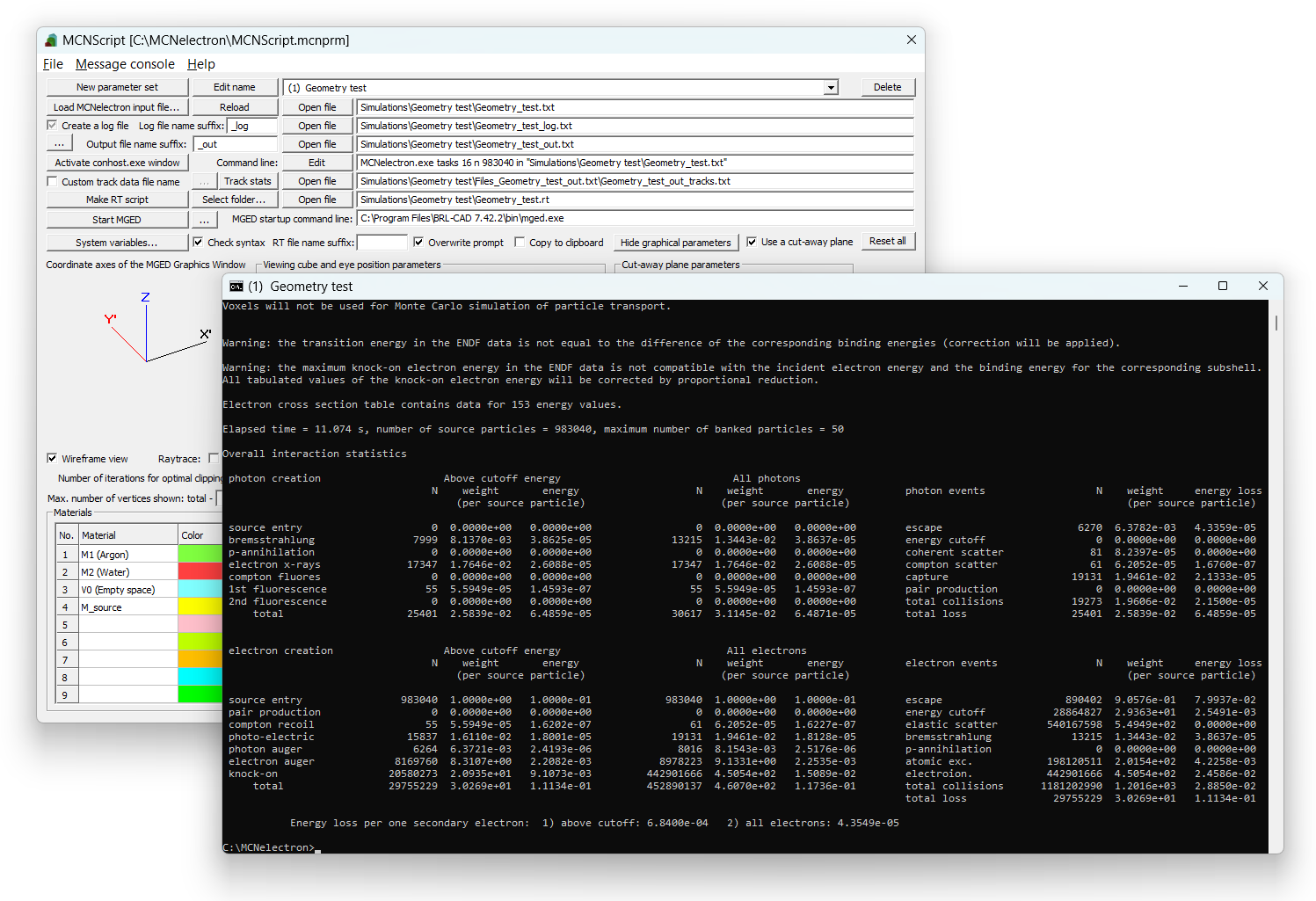
MCNScript is an open-source front end for MCNelectron, designed to simplify running Monte Carlo simulations and producing visual output. It provides a dialog interface for editing command‑line arguments, controlling particle‑track statistics and filtering, organizing MCNelectron input and output files, and creating rendering scripts for graphical inspection. The raytracing scripts created by MCNScript must be loaded by MGED (Multi-Device Geometry Editor – a part of the open-source software package BRL-CAD), which generates raytraced or wireframe images from 3D models using the constructive solid geometry technique.
ZIP archive with the source code and VS2022 project for compiling MCNScript v1.0.6 (updated on September 5, 2026)
MCNScript User’s Manual
List of changes in MCNScript
MCNelectron v1.0.9 was used for simulations described in this article:
A. Poškus, Monte Carlo estimation of average energy required to produce an ion pair in noble gases by electrons with energies from 1 keV to 100 MeV // Journal of Nuclear Science and Technology, vol. 52, No. 5 (2015), p. 675 – 686.
[Published online: 04 Nov 2014, link: https://dx.doi.org/10.1080/00223131.2014.974710]
MCNelectron v1.1.1 was used for simulations described in this article:
A. Poškus, Evaluation of computational models and cross sections used by MCNP6 for simulation of electron backscattering // Nuclear Instruments and Methods in Physics Research Section B, vol. 368 (2016), p. 15 – 27.
[Published online: 17 Dec 2015, link:
https://www.sciencedirect.com/science/article/pii/S0168583X15012203]
MCNelectron v1.2.0 was used for simulations described in this article:
A. Poškus, Evaluation of computational models and cross sections used by MCNP6 for simulation of characteristic X-ray emission from thick targets bombarded by kiloelectronvolt electrons // Nuclear Instruments and Methods in Physics Research Section B, vol. 383 (2016), p. 65 – 80.
[Published online: 29 Jun 2016, link:
https://www.sciencedirect.com/science/article/pii/S0168583X1630283X]