Lithuania in Europe’s Economic Race: How a Small Baltic Nation Is Sprinting Past Its Rivals

2026-04-17 18:53
Economics & Science · Research Digest

Economic Research

A new mathematical model reveals why Lithuania may top Central and Eastern Europe in GDP per capita by 2030 — and what a flock of starlings has to do with it.

In late March 2026, a new seminar series opened at the Institute of Lithuanian Scientific Society — named after the economist Jonas Pranas Aleksa. The inaugural talk was delivered by Prof. Vygintas Gontis, and its subject was deceptively modest: how Lithuania managed to become one of the fastest-growing economies in Central and Eastern Europe. The answer, it turns out, involves birds.

The research behind the lecture, published in two recent papers on arXiv, proposes a fresh lens for understanding how economies grow. Forget the usual policy prescriptions and microeconomic tinkering. What if the most important dynamics of economic development happen at the macro level — visible only when you step back far enough to see the whole flock?

The Murmuration of Markets

Have you ever watched a murmuration of starlings — that fluid, shape-shifting cloud of thousands of birds moving as one? No single bird is in charge. No one issues commands. Each bird simply watches its neighbours and adjusts. The result is breathtaking collective intelligence.

„Countries don’t need to invent the smartphone from scratch. They just need to watch someone else profit from it.”

Prof. Gontis and his collaborators argue that technology adoption among nations works the same way. They call it the herd model. When a wealthier country adopts a technology and visibly prospers, neighbouring countries notice — and imitate. Two forces drive this imitation:

Force 1 — Personal incentive

„This new technology lets me earn more.” Pure rational calculation.

Force 2 — Social pressure

„Everyone else is adopting it. If I don’t, I’ll fall behind.” The herd instinct.

Together, these two forces create a powerful engine of catch-up growth — especially for countries that are far behind the technological frontier. The further behind you are, the faster you can theoretically catch up, because the gap between your current state and what’s possible is enormous.


The Mathematics of Catching Up

To turn this intuition into something testable, the researchers built a mathematical model. It is elegant in its simplicity: each country begins at some level of technological development, the most advanced countries set a moving frontier, and lagging nations close the gap over time — but not at the same rate.

As a country nears the frontier, the pace of catch-up slows. This makes intuitive sense: there are fewer obvious imitation opportunities left, and the remaining innovations are genuinely hard to copy. The model produces a characteristic S-shaped curve of productivity growth.

The researchers tested this model against decades of real data from Central and Eastern European countries, comparing them against benchmarks like Germany and the United States. The fit was striking. Countries genuinely do follow the predicted trajectory — accelerating when far behind, slowing as they approach the leaders.


The Secret Variable: Debt

But not all countries catch up at the same speed. Some sprint. Others jog. A few stumble. What explains the difference?

The researchers found a surprisingly powerful predictor: private sector debt. Specifically, the level of household and corporate borrowing from banks.

Key Finding In one of their papers, the authors demonstrate that the single greatest influence on a Central or Eastern European country’s catch-up speed is the trajectory of its private debt. Countries that built up excessive credit before the 2008 financial crisis are still paying the price — literally — in slower productivity growth.

Countries that over-borrowed before 2008 spent the following decade deleveraging — paying down debt rather than investing in new technologies. This depressed their catch-up speed precisely when they should have been accelerating.

Lithuania’s story is the inverse. It entered the 2008 crisis with relatively modest private debt levels. The crisis was painful — Lithuania suffered one of the sharpest GDP contractions in the EU — but the country emerged leaner, with its balance sheets clean and its capacity to invest intact. The low-debt position, the model suggests, is the structural reason Lithuania has since been able to grow so fast.

#1 Projected CEE ranking by GDP per capita in 2030
1995 Start year for the CEE economic dataset used in the model
2050 Forecast horizon in the longer-term model projections

Contrasts: Romania Rockets, Slovenia Stalls

The elegance of the model lies in what it reveals about individual countries’ trajectories. Two contrasting cases stand out.

Romania started from a very low productivity base — which actually works in its favour. With such a large gap to close, even modest technology adoption generates dramatic percentage gains. The model projects rapid growth continuing well into the 2030s.

Slovenia, meanwhile, presents a cautionary tale. It began from a higher base than most CEE countries — closer to the Western European frontier — but its private debt dynamics have weighed on its catch-up speed. The model predicts slower convergence, confirming what the data has shown for the past decade.

Lithuania’s low pre-crisis debt isn’t just historical trivia. The model treats it as the decisive structural advantage that explains the country’s exceptional economic sprint.

A Different Way of Seeing Economics

Perhaps the most intellectually interesting aspect of this research is its methodological stance. The authors explicitly reject the conventional microeconomic approach of building up from individual agents, firms, and market interactions.

Instead, they adopt the perspective of an outside observer watching the whole system. Like a biologist studying a murmuration rather than tracking individual birds, they look for macro-level patterns — the collective dynamics that emerge from millions of individual decisions but cannot be reduced to any of them.

This approach, borrowed partly from statistical physics, allows them to sidestep the „noise” of micro-level fluctuations and identify the underlying signal: the smooth, predictable curve of technological catch-up. The model is explicitly approximate. It doesn’t account for political upheaval, institutional quality, or individual crises. But its authors argue that this simplicity is a virtue — it reveals the structural forces that operate beneath the policy noise.

IMF & Model Consensus Forecast — 2030

Lithuania overtakes all Central & Eastern European peers in GDP per capita

Driven by the lowest pre-crisis private debt accumulation in the CEE region


Why This Matters Beyond Lithuania

The implications reach well beyond one small Baltic nation. If the herd model is correct, then economic policy advice that ignores private debt dynamics and focuses only on innovation, education, or institutional reform may be missing the central variable.

It also offers a more optimistic reading of development economics. Growth, in this view, is not primarily about rare genius or fortunate geography. It is a social process — systematic, learnable, and to a significant degree predictable. Countries that watch, imitate, and invest wisely will catch up. The mathematics says so.

For Lithuania, the message is one of hard-won vindication. The brutal austerity of 2009–2010, widely criticised at the time, left the country with clean books precisely when it needed them most. The sprint that followed wasn’t luck. It was structure.

The Bottom Line

Economic growth isn’t only about inventing new things. It’s about the social process of watching, learning, and adopting what works — fast enough to matter. Lithuania’s advantage isn’t genius or luck. It’s a balance sheet kept clean when others borrowed recklessly. The mathematics of catch-up says the sprint isn’t over yet.


Is the United States’ Productivity Advantage Merely a Result of the Chosen Measurement Methodology?

2025-12-09 18:07

Global economic media frequently report that U.S. productivity has been growing much faster than in Europe and other developed Western economies for many years. As an example, consider the recent publication in the Financial Times (FT) [1]. This is not journalistic exaggeration—such conclusions follow directly from the still widely used methodology of calculating real GDP and productivity, and from international comparisons based on that methodology.

(more…)

Ar gali Lietuvos ekonomika pavyti ir aplenkti Vakarų valstybes?

2025-11-06 14:55

Ar Lietuva gali pasivyti ir aplenkti Vakarų Europą? Šis klausimas provokuoja, bet ne be pagrindo. Neseniai atliktas tyrimas (Gontis et al., 2025, arXiv:2510.04211) parodė, kad Lietuvos ekonominė pažanga išsiskiria tarp Centrinės ir Rytų Europos (CRE) valstybių. Tačiau ar šis tempas leis pasiekti Maltos ir kitų Vakarų šalių lygį? Pasitelkę tuos pačius duomenis ir metodiką, palyginome Maltos bei Ispanijos raidą, kad išsiaiškintume, kokie veiksniai lemia sėkmingą konvergenciją.

Maltos pavyzdys rodo, kad net mažos, atviros ekonomikos gali pasiekti reikšmingą pažangą ir žengti į išsivysčiusių šalių lygį. Tuo tarpu Ispanijos konvergencija sustojo, atskleisdama ribotas galimybes spartesniam augimui. Šių skirtumų analizė padeda įvertinti, kokį vaidmenį vaidina tiesioginės užsienio investicijos (TUI), kainų lygis ir valstybės skolos dinamika. (more…)


Nuo bandos jausmo iki ekonominio rezonanso: kaip įkaista prisotinta rinka

2025-11-02 09:50

Įžanga: kai sistema ima dūgzti.
Kartais atrodo, kad ekonomika ima dūgzti kaip bičių avilys. Kainos kyla, visi perka, visi kalba apie tą patį – akcijas, būstą, kriptovaliutas. Kas iš tikrųjų įvyksta, kai rinka tarsi praranda savo racionalumą ir ima judėti vienu balsu? Kodėl atskiros ekonominės sprendimų dalelės – žmonės – staiga ima elgtis taip, tarsi juos jungtų nematoma energijos banga? Šį reiškinį vis dažniau bandoma aiškinti pasitelkiant fizikos sąvokas, o viena iš jų – rezonansas – leidžia pamatyti, kaip socialinė ir finansinė dinamika iš tiesų turi bendrų bruožų. (more…)


Lietuvos ekonominės sėkmės svarbiausia priežastis – maža privati skola.

2025-10-14 19:32

Su VILNIUS TECH tarptautinės makroekonomikos dėstytoja, Ternopilio nacionalinės ekonomikos akademijos profesore Lesya Kolinets parengėme mokslinės publikacijos rankraštį: https://arxiv.org/pdf/2510.04211 apie Centrinės ir Rytų Europos (CRE) ekonominę raidą 1995-2024 metals. Šio tyrimo rezultatas gali sudominti platų ratą skaitytojų, norinčių giliau suprasti Lietuvos ekonominės sėkmės priežastis po nepriklausomybės atgavimo. Nesudėtingomis ekonometrinėmis priemonėmis stengiamės išskirti svarbiausias CRE ekonomikos augimo makroekonomines ir finansines koponentes, tarp kurių išskirtinai svarbia tampa šalių sukaupta privati skola.
Nors straipsnis dar nėra paskelbtas jokiame ekonomikos mokslo žurnale, norime pasidalinti jo išvadomis su specialistais Lietuvoje. Jūsų mintys, kritika ir pastebėjimai gali būti naudingi straipsnį tobulinant ir tęsiant tyrimą dar platesniame kontekste. (more…)


Pristatome savo naujausią mokslinį darbą.

2023-10-29 19:43
Spauskite paveikslėlį, jei norite atsidaryti straipsnio .pdf bylą.
<p>Tyrinėdami socialines sistemas ir ypatingai finansines turime pasirinkti prielaidas ir matematinį (stochastinės laiko eilutės) ar fizikinį (agentų) modelį. Nepaisant to, kad empirinių duomenų prieinamumas pasiekė dar neregėtas galimybes, tinkamo, teisingo modelio pasirinkimas išlieka sunkiausiai sprendžiama problema. Pavyzdžiui, tiriame empirines sistemas, ieškodami jose ilgos atminties ir prognozavimo galimybių, naudodami matematinius laiko eilučių modelius, kuriuose ta atmintis yra išankstinė prielaida. Akivaizdu, kad taip įvertinta tiriamos sistemos atmintis turi prasmę tik tuo atveju, jei teorinė prielaida apie tos atminties kilmę atitinka tikrovę.</p>
<p>Savo ankstesniame darbe [1] tyrėme sandorių pavedimų srauto finansų rinkose laiko eilutes, remiantis pačia bendriausia Trupmeninio L’evy stabilaus stochastinio proceso (TLSSP) prielaida, ir parodėme, kad šios prielaidos pagrindu turime pripažinti pavedimų srauto antikoreliacines savybes.  Tiriamas laiko eilutes apibrėžėme pačiu paprasčiausiu būdu, sumuodami
pavedimų apimtis: pirkti [latex]v_k^{+}(t_j)[/latex] ir parduoti \(v_k^{-}(t_j)\) akcijas</p>
\[
X(j)=\sum_{k=1}^{10}(v_{k}^{+}(j)-v_{k}^{-}(j))=V^{+}(j)-V^{-}(j)=\sum_{i=1}^{j}Y(i).\label{eq:order-disbalance}
\]
Čia \(X(j)\) yra sandorių (nuomonių) disbalansas laiko momentu \(j\),
indeksas \(k\) žymi 10 kainos lygių virš ir žemiau pirkti-parduoti
tarpo, \(V^{+}(j)\), \(V^{-}(j)\) atitinkamai reiškia bendras apimtis
pirkti ar parduoti akcijas momentu \(j\), \(Y(i)\) yra disbalanso pokyčiai,
kurie atsiranda dėl prekiautojų teikiamų pavedimų pirkti parduoti
akcijas.
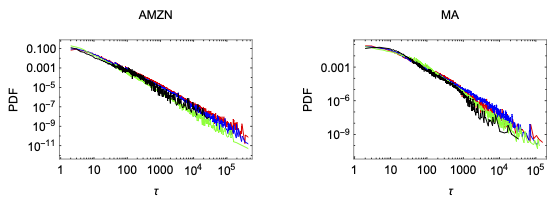
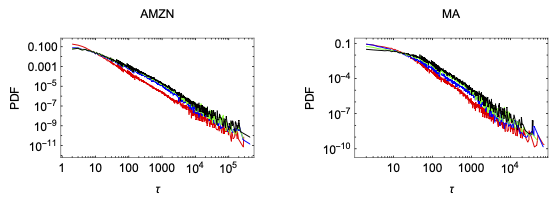
<p>Visdėlto, detalesnis tyrimas parodė, kad pasirinkta matematinė prielaida yra nepakankama, kai pavedimų srautas apima ir jų atšaukimą bei įvykdymą. Tyrimui taikomą modelį turime tikslinti, atsižvelgdami į pavedimų gyvavimo laikų laipsninio pobūdžio skirstinį. Šį empirinį pastebėjimą siūlome interpretuoti, kaip dar vieną finansinių laiko eilučių stilizuotą faktą. Empiriškai nustatytą gyvavimo laikų statistinę savybę iliustruojame dviem žemiau pateiktais histogramų paveikslėliais.</p> 
Pav. 1. AMZN ir MA akcijų pavedimų gyvavimo laikų histogramų pavyzdžiai. Empiriniai skirstiniai yra suskaičiuoti keturiems pavedimų kainų lygiams vieno mėnesio duomenų laikotarpiui. Raudonas grafikas yra pirmam kainos lygiui, mėlymas antram, žalias trečiam ir juodas ketvirtam.
Pav. 2. AMZN ir MA akcijų pavedimų gyvavimo laikų histogramų pavyzdžiai. Empiriniai skirstiniai suskaičiuoti keturiems skirtingiems pavedimų dydžio intervalams. Didėjimo tvarka: raudonas, mėlynas, žalias ir juodas grafikai. 
<p>Kadangi pavedimų gyvavimo laikų skirstiniai akivaizdžiai yra laipsninio pobūdžio (grafikai yra dvigubai logaritminiane mastelyje), pasinaudojome galimybe pasitelkti neekstensyviąją Tsallio statistiką, t.y., parodėme, kad q-eksponentinis Tsallio skirstinys puikiai aprašo empirinį gyvavimo laikų pasiskirstymą. Papildydami šią empirinę statistinę savybę pavedimų apimčių (volume) laipsniniu empiriniu pasiskirstymu, suformulavome paprastą disbalanso laiko eilutės modelį, kuris esmingai pakeitė anksčiau naudotą Trupmeninį L’evy stabilų stochastinį procesą.</p>
<p>Pasirodė, kad ankstesnė TLSSP prielaida visai neblogai tinka tuo atveju, kai laiko eilutę formuojame tik iš akcijų rinkai pateikiamų pavedimų, bet išimame jų atšaukimus ir įvykdytus sandorius. Todėl atkreipiame dėmesį, kad šis konkretus empirinės laiko eilutės pavyzdys gražiai demonstruoja, kaip yra svarbu įsitikinti ar tyrimams naudojamos matematinės prielaidos yra tinkamos tiriamam objektui. Mūsų nuomone, empiriniuose laiko eilučių tyrimuose labai dažnai prielaidų galiojimas nėra tinkamai patikrinamas, o gaunami rezultatai, ypatingai ilgos atminties aspektu, yra klaidinantys. Tik pagrįstai įvertinę ilgos atminties egzistavimą fizinėse, socialinėse ar finansinėse sistemose, galime tikėtis sėkmės, prognozuodami laiko eilučių eigą ar skaičiuodami rizikas. </p>
<p>Šis darbas gali būti prasmingai pratęstas, jei pabandytume apjungti šiuos rezultatus su mūsų grupės kolegų publikacija [2]. Yra tikėtina, kad pavedimų laikų laipsniniai skistiniai stebimi todėl, kad rinka statistiškai apjungia labai įvairius agentus, prekiaujančius labai skirtingu intensyvumu, t.y., turinčius skirtingus charakteringus jų pavedimų gyvavimo laikus. Kviečiame susidomėjusius fizikos matemtikos studentus bei jaunus mokslininkus bendradarbiauti, tęsiant pradėtus darbus.</p> 

Literatūra.

  1. V. Gontis. Order flow in the financial markets from the perspective of the Fractional Lévy stable motion. Communications in Nonlinear Science and Numerical Simulation 105, 2022, psl. 106087. https://www.sciencedirect.com/science/article/pii/S1007570421003993doi: https://doi.org/10.1016/j.cnsns.2021.106087.
  2. A. Kononovicius, B. Kaulakys. 1/f noise in electrical conductors arising from the heterogeneous detrapping process of individual charge carriers. (under review). arXiv:2306.07009 [math.PR].

WP2Social Auto Publish Powered By : XYZScripts.com